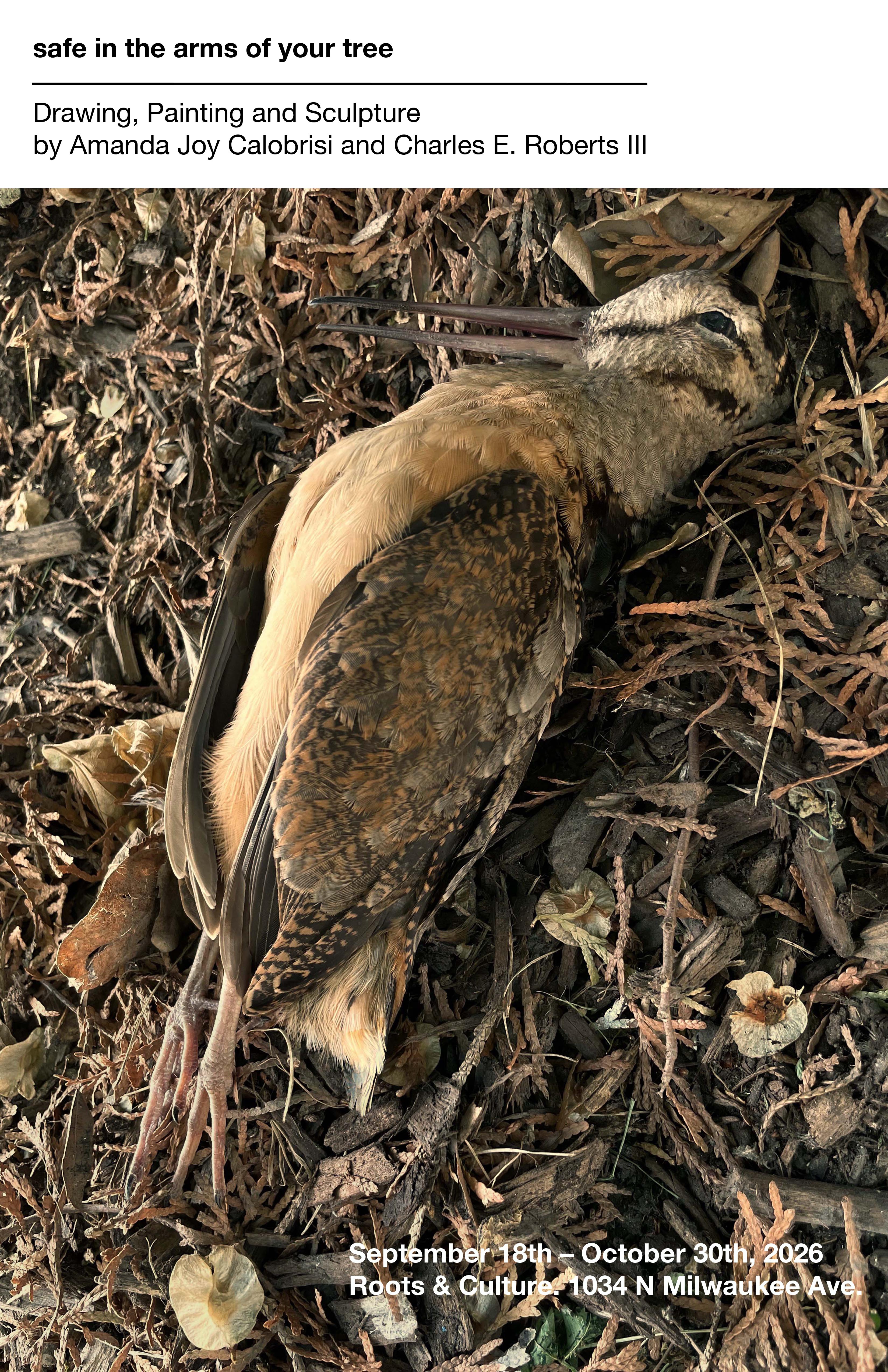
safe in the arms of your tree: Amanda Joy Calobrisi & Charles E. Roberts III
Opening Friday, September 18th 6–9pmFor the final two shows of our 20th anniversary year, we are appraising our flagship two-person exhibition program, Double Exposure. We put together two special shows for the fall season by taking a deep dive into our archive of past submissions. These artists are the ones that got away, who we regret having never shown.
The curation of these shows is meant to illuminate an important value of Roots & Culture—honoring the dignity of our applicants. We are sensitive to the time and energy that artists dedicate to submitting proposals. As artists, ourselves, we are intimately familiar with the sinking feeling of receiving rejections. To approach the rejection process with empathy and intentionality, we have always written personalized response letters to each applicant; offered studio visits to runners-up in the finalist pool; and prioritized repeat applicants in our review process. These returning artists have shown both a strong desire and determination to exhibit at Roots & Culture. This season of Double Exposure features four artists who have never shown with the program, who had the grit to apply multiple times, and who make work that is so good that we’ve carried regret that we never were able to work together.
Our first show of the season features Amanda Joy Calobrisi and Charles E. Roberts III, both artists working in figurative, narrative image-making whose dialogue runs deep, as they are life partners of twenty six years. Both artists applied to Double Exposure (in separate submissions) over the 2017-2019 seasons and we were happy to work with them both with our since-defunct window installation project. We believed in their practices so strongly we were left with a nagging desire to see fully realized exhibitions in the main gallery space. With their enchanted story-telling, their work echoes back to our very first show, Explore Your World, a group show featuring artists working with narrative approaches to painting and drawing.
About the artists’ work in their own words:
Amanda Joy Calobrisi
This body of work has allowed me to ponder the theatrics of femininity and acknowledge a disconnect between what one feels on the inside verses what one sees on the outside. The vintage black and white photo references that I use become something else through the process of translating them into paint, graphite or clay. The bold high pitched colors or the density driven marks reinvent and reanimate the figures in attempt to bring back an awe and mystery to images of women -a re-enchantment. Using formal tactics I attempt to embolden the figures’ gestures and give them power.
I want to make visual the unnamable feelings that I feel when I stand close to a prehistoric female figurine in a museum. My discovery of the ancient gesture called anasyrma has guided all my compositions since, the poses I choose recall Sheela-na-gig, Baubo, Ama-no-Uzume and countless other Eurasian sacred display figures.
The paintings, drawings and sculptures make space for the awkward, the generous, the amorous, the skeptical, the self-indulgent and the reserved. I attempt to psychologize the body in ways that confuse and distort the expected. My work invites an open and receptive viewer. A beholder with the ability to empathize with painted figures both psychologically and kinesthetically and have the imagination to think beyond the patriarchal logic. It is my desire that this kind of looking upsets the established order of reading images of women -as bodies to be consumed. The narratives that appear in my work include an imagined cast of lyrical archetypes that I call non-conformists, sensualists, self-revelers, presenters, twin flames, piggyback-girls (ephedrismos), flashers, pisseuses and skeptics. These painted women contemplate, investigate, and celebrate their bodies. They fold, bend, lean and stretch in pursuit of new perspectives and to see themselves more clearly.
Charles E. Roberts III
It recently occurred to me that all the elements of my pictures can be traced back to the front and back yards of my childhood home.
My backyard was essentially the woods, beyond which lay a cornfield and a cemetery whose solitary lantern could always be seen from my bedroom window at night. Those woods were host to much adventure and plenty of misadventure. I was intimately familiar with most of the trees—not by genus or species, but by their designated roles in my elaborate fantasies. Most played the parts of fortresses, ships, and hungry beasts, but many were cast as “just people.” One afternoon, this battleground of good and evil became something else entirely when I found the tattered remains of some dirty magazines, their glossy skin tones neatly camouflaged in a pile of autumn leaves.
Across the street from my front yard was the Catholic church that my mother, sister, and I attended. Those Sunday hours could be tedious, but there was just enough blood ritual and ornament in that small-town parish to keep me conscious and curious. The pantheon of saints seemed to rival the gods and demigods of ancient myth; their lives were far more chaste, but their demises were usually a grand guignol delight.
Amanda Joy Calobrisi is an artist living and working in Chicago, IL. She is part-time faculty in the Painting and Drawing Department at the School of the Art Institute of Chicago, where she received her MFA in 2008. She has exhibited her work at various galleries in Chicago including Western Exhibitions, Co-prosperity Sphere and the Chicago Artist Coalition. Other opportunities have been in New York, LA, San Francisco, Detroit, CDMX, Mexico, Berlin, Germany and Fujioka and Kofu, Japan.
Charles E. Roberts III is an artist currently based in Chicago, Illinois. They studied painting and drawing in Boston Massachusetts but after graduating spent the next twenty-three years working primarily in assemblage, sculpture, installation and video. They returned to drawing in 2020 and have devoted themselves solely to this practice ever since.